Slow Mo Run
- 4.1
- Rating
- 100.00M
- Installs
- Free
- Price

 Analysis by App-foxy
Slow Mo Run is the kind of casual game I open when I want something immediate rather than something I need to study. Its central idea is easy to understand: guide a runner through exaggerated slow-motion fights and obstacles, then try to keep the action looking as smooth and ridiculous as possible. That simplicity is a strength, but it also means the game depends heavily on timing, presentation, and how much variety each short session can offer.
After spending time with it, I see the appeal clearly. The game turns ordinary running into a sequence of dramatic pauses, awkward poses, and sudden movements. It feels closer to directing a tiny action-comedy scene than to playing a traditional endless runner. The controls are approachable, the visual language is easy to read, and a failed attempt usually feels like a small joke rather than a serious setback.
At the same time, this is not the best choice for someone looking for deep progression, a large world, or demanding long-term strategy. It belongs firmly in the casual game space, and its value comes from quick entertainment. Supersonic Studios LTD has built it around a recognizable gimmick and a very specific mood: playful, kinetic, and deliberately overdramatic.
You May Also Like

 AccuWeather: Weather Radar
AccuWeather Review: A Quick, Clear Forecast for Everyday Decisions
For everyday plans, the best forecast is the one you can understand quickly. AccuWeather makes rain timing, radar, and local conditions easy to act on, with a few trade-offs.

 Hill Climb Racing
Why Hill Climb Racing Still Turns Crashes Into One More Run
A tiny car, a bumpy hill and one more upgrade: Hill Climb Racing keeps resurfacing because its simple chaos makes every near-miss feel personal.

 AliExpress - Shopping App
AliExpress Makes Global Shopping Feel Personal, but Shoppers Bear the Risk
AliExpress turns a global marketplace into a pocket-sized discovery engine. Its reach is useful, its shopping loop compelling, and its trade-offs easy to miss.

 Lords Mobile: Kingdom Wars
Lords Mobile Is a Kingdom-Building Routine, Not a Quick Match
A case-by-case verdict on the building, battles, device demands, and social commitments that make Lords Mobile rewarding for some players and exhausting for others.

 PDF Scanner app - TapScanner
TapScanner Makes Paperwork Easier to Capture, Check, and Share
TapScanner makes scanning with a phone feel less like a rescue operation and more like a dependable step in getting work done. Its capture tools are useful, though not flawless.

 Block Blast!
 Shows How Much a Puzzle Game Can Leave Out
A quiet grid game shows why puzzle players increasingly value instant clarity, repeatable skill and low-pressure play—and where the genre still needs to catch up.
More From Our News Desk
View All News


Why the first few runs are so easy to understand
The first impression is almost entirely about clarity. You see a runner, an obstacle or opponent, and a moment that needs a response. The slow-motion concept gives you time to notice what is happening, but it does not remove the need for attention. I found that the game communicates its immediate goal without burying it under menus or complicated instructions.
That makes the game particularly comfortable for short sessions. I can imagine playing it while waiting for a coffee, taking a brief break from work, or handing it to someone who does not normally play mobile games. There is no need to remember a complicated control scheme before enjoying the first attempt. The action begins quickly, and the humor comes from watching a simple movement become an exaggerated stunt.
The title also benefits from a strong contrast between speed and suspension. The runner appears to be moving through a fast situation, yet the important moments stretch out long enough for me to react. That contrast gives the game its identity. Without it, the experience would be another basic running game; with it, even a familiar obstacle can become a small performance.
One useful habit is to treat each sequence as a visual cue exercise rather than simply swiping or tapping as quickly as possible. I get better results when I watch the character’s position and the shape of the upcoming action instead of reacting to the overall chaos. The game rewards calm observation more than frantic input, which is a nice fit for a casual title that wants to feel exciting without becoming exhausting.
The game is free to play, which makes trying it straightforward. Its store rating sits at a 4.1 average from around 381 thousand ratings, and it has passed over 100 million installs. Those figures help explain why the concept has traveled well: the premise is understandable in a few seconds, and the visual joke works even when someone is watching over your shoulder.
A visual world built from motion rather than lore
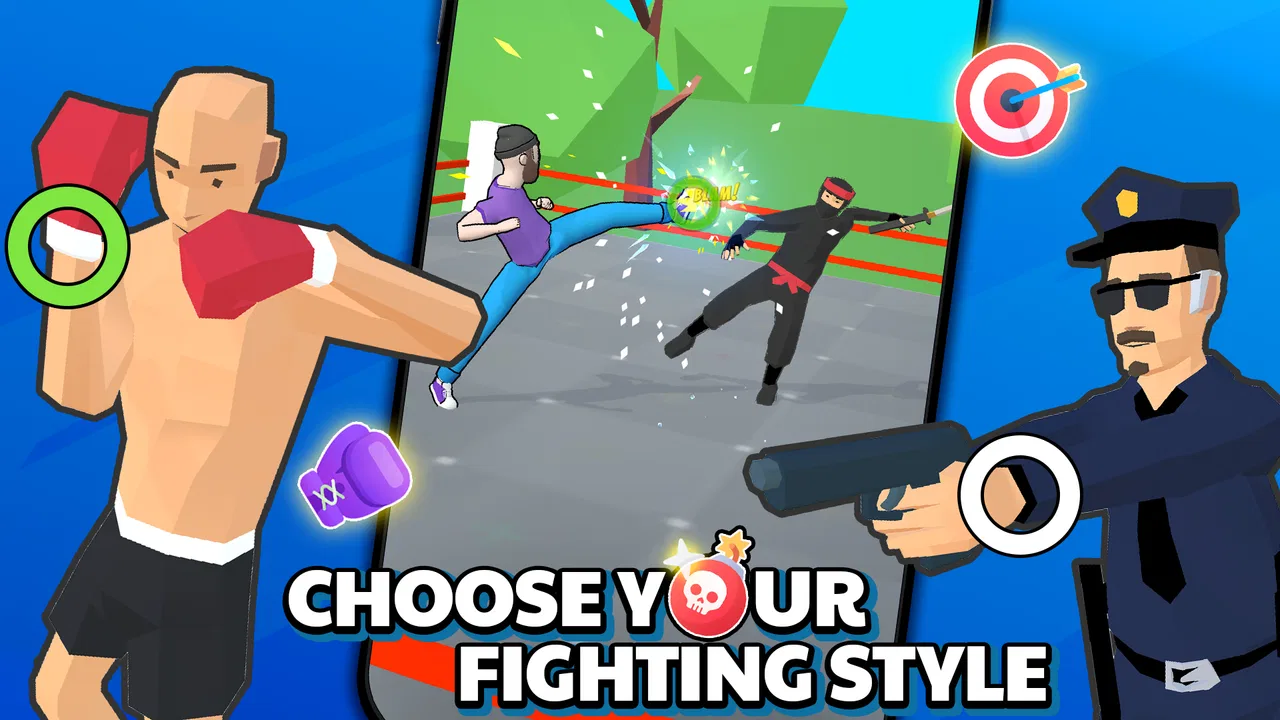
Slow Mo Run does not need a complicated fictional setting to create a recognizable world. Its setting is expressed through movement, staging, and the way each challenge is presented. The runner is placed in situations that feel like miniature action scenes, but the tone stays light instead of becoming genuinely threatening. I read the world as a playful parody of cinematic combat, where the pose after a move can be as important as the move itself.
The art direction supports that interpretation. The characters and obstacles are designed to be read quickly, so the game can keep its focus on the next physical beat. This is important in a slow-motion game: if silhouettes, positions, or gestures were difficult to distinguish, the central mechanic would feel unfair. Instead, the visual presentation usually gives me enough information to understand what the scene is asking for.
What I like most is the way the game makes awkwardness part of its charm. A perfect-looking action moment is satisfying, but a slightly clumsy movement can also be funny. The character’s exaggerated body language gives the game personality without needing long dialogue or a detailed narrative. It is a visual language based on timing and posture.
That choice has a trade-off. Players who prefer richly decorated environments, character backstories, or a sense of exploration may find the presentation thin. The world is not trying to be a place I can wander through. It is a stage for short physical jokes. I think that is coherent, but it narrows the audience.
For me, the strongest way to appreciate the art direction is to stop treating every run as a score attempt. Watch how the character enters a scene, how the action pauses, and how a small input changes the pose. The game’s personality appears in those transitions. It is less about building a grand universe and more about making each brief encounter visually legible and amusing.
How sound and pacing make the action feel playful
The pacing is the real glue between the controls and the presentation. Slow motion creates room for anticipation, then releases it through a quick movement or impact. That pattern gives the game a simple rhythm: notice, react, watch the result, and prepare for the next beat. Even when the underlying action is uncomplicated, this rhythm helps each section feel like a compact scene.
Sound contributes by reinforcing the sense that every movement matters. The game’s mood is not built around tension in the serious sense; it is built around comic timing. A pause before an action can make the next sound or movement feel larger than it would in real time. That exaggeration suits the visual style and keeps the game from feeling like a plain obstacle course.
I also think the pacing makes the game more welcoming than many fast runners. In a conventional runner, missing a visual cue can feel like a reflex test that was over before I understood it. Here, the slowed presentation gives me a chance to interpret the scene. The challenge still comes from choosing the right response, but the game leaves more space for observation.
There is a practical downside: the same rhythm can become predictable if I play for too long in one sitting. Because the core pleasure comes from the reveal of each movement, repeated patterns lose some of their surprise. My preferred approach is to play in short bursts, where the comic timing remains fresh. This is not a criticism of the concept so much as a reminder of what kind of game it is.
A useful tip is to play with the sound on when possible, especially during the first sessions. The audio helps me feel the spacing between actions and makes the scenes more coherent. If I play silently, the game still functions, but some of its theatrical quality disappears. For players who mainly want a quick visual distraction, that may not matter; for anyone judging the overall atmosphere, sound is part of the experience rather than decoration.
Where the controls fit the slow-motion idea
The mechanics work because they are closely tied to the game’s presentation. I am not managing a large inventory, building a character, or planning a route across a map. I am making timely inputs during a sequence that wants me to notice the body, the obstacle, and the moment of contact. That narrow focus keeps the controls accessible and lets the slow-motion gimmick remain central.
The best runs come from reading the scene before acting. I found it tempting at first to respond immediately whenever something moved, but the game is more enjoyable when I wait for the useful cue. In practical terms, this means watching the runner’s position, identifying what the next movement appears to demand, and avoiding unnecessary input. The slow pace is not permission to switch off; it is an invitation to be deliberate.
This creates an interesting balance. The game feels casual because the controls are easy to approach, yet the timing can still separate a satisfying run from an awkward one. That is a good mechanical fit for brief play. I can improve through attention without needing to memorize complex systems.
The trade-off is limited depth. Once I understand the basic relationship between cue and response, the experience depends on how much I enjoy seeing that idea applied to new scenes. Players who want branching decisions, equipment choices, or a strategic layer will likely outgrow it. A more traditional action game would offer greater control, while a classic endless runner might offer stronger emphasis on route selection and score optimization.
Slow Mo Run is better suited to people who enjoy timing-based comedy than to players seeking a serious combat game. The word “fight” in the premise should not set the expectation of a full fighting system. The emphasis is on staging a funny slow-motion encounter, not mastering a roster of characters or learning a detailed move set.
The game is rated Teen, so I would still check whether its tone fits the person who will be playing, especially when sharing a device with a younger family member. Its cartoon-like presentation makes the action feel playful, but the theme is still built around fighting. That distinction matters more than the simple fact that the controls are easy.
Free access, optional spending, and the right session length
Because the game is free, it is easy to test without committing money at the start. That is useful for a title whose appeal is so dependent on personal taste. Some players will immediately enjoy the slow-motion staging; others will understand the joke but find the repeated structure too narrow.
There are in-app purchases priced from $3.99 to $5.99 per item. I would approach those carefully and first decide whether the basic loop is holding my attention. Spending can make sense for someone who plays regularly and wants to support the experience, but it does not change the fundamental question of whether this particular style of casual action is enjoyable for them.
My own recommendation is to avoid judging the game after one rushed attempt. The first run explains the idea, but a few more attempts reveal whether the timing feels satisfying or merely amusing once. On the other hand, I would not force long sessions just to search for depth that the design is not aiming to provide. The game works best when I accept its compact format.
The current version is 11.0, and it runs on devices using Android 7.0 or later. That makes it accessible across a broad range of Android phones and tablets, although the practical experience can still vary with screen size, touch response, and general device performance. A smaller screen may make the action feel more concentrated, while a larger display can make the visual staging easier to follow.
Who should play it, and who should choose something else
I would recommend this game to someone who likes short, visual challenges and enjoys comedy built from exaggerated movement. It is especially suitable for players who want an easy entry point, a game that can be understood quickly, and a reason to replay a scene simply because the timing feels funny.
A realistic everyday use case is a ten-minute break between tasks. I can start a run without preparing a loadout or remembering a long-term objective, focus on a handful of slow-motion encounters, and stop without feeling that I have abandoned a complicated campaign. That makes it more convenient than many larger casual games when I only have a small amount of attention available.
I would skip it if my priority is exploration, narrative, competitive depth, or a broad collection of systems. Someone who wants a conventional runner may prefer a game centered on continuous speed and route control. Someone who wants combat mastery will be better served by a dedicated action or fighting game. Someone who dislikes repeated attempts may also find the core loop too dependent on replaying similar kinds of timing moments.
Compared with usual casual runners, this game trades constant forward momentum for staged pauses. Compared with fighting games, it trades technical control for presentation and accessibility. That middle position is its main advantage and its main limitation. It is distinctive because it does not fully belong to either group, but it cannot satisfy every expectation associated with them.
The atmosphere works because every part points in the same direction
My final impression is that the game’s art direction, sound, setting, and pacing are unusually aligned with its central idea. The visuals make the body readable, the audio supports the comic beat, and the slow-motion structure gives each encounter room to land. None of these elements tries to turn the game into something grander than it is, and that restraint helps the mood stay consistent.
The strongest insight I took from playing is that the game is not really about moving quickly. It is about making a quick action feel important by stretching the moment around it. That is why careful observation often works better than frantic tapping, and why playing in short sessions preserves more of the humor. The design rewards attention to presentation as much as success in the sequence.
There are clear limits. The concept can lose freshness during extended play, the mechanical layer is intentionally light, and the fighting theme should not be confused with a deep combat system. Optional purchases also mean that players should decide for themselves whether the free experience already provides enough value. These are not hidden flaws, but they are important when comparing it with fuller alternatives.
Still, I think Slow Mo Run earns its place as a distinctive casual game. Supersonic Studios LTD has taken a simple running structure and given it a coherent playable mood, using slow motion to turn ordinary inputs into little action-comedy scenes. If you want a quick, readable game with exaggerated movement and a playful rhythm, I would happily suggest giving it a try. If you need a deep system or a world to get lost in, I would look elsewhere.
In short, this is a good choice when the goal is not to build a long gaming habit but to enjoy a few carefully timed moments. Its best quality is the way mechanics and atmosphere reinforce each other: the game looks funny because it plays slowly, and it feels responsive because the pacing gives each movement room to breathe. That focused identity is what makes it memorable.
FAQs for Slow Mo Run
01What is Slow Mo Run, and how does the gameplay work?
Slow Mo Run is a casual running game built around timing, reflexes, and funny slow-motion animations. Your character automatically moves through each level while you control actions such as jumping, ducking, punching, kicking, or changing position. The objective is to react at the right moment, avoid obstacles, defeat opponents, and reach the finish line successfully. Later stages generally require faster reactions and more accurate controls.
02Is Slow Mo Run free to download and play?
Yes, Slow Mo Run can generally be downloaded and played for free on supported mobile devices. However, the game may include advertising and optional in-app purchases, depending on the version and platform. Ads can appear between stages or after completing certain actions, while purchases may offer cosmetic items or other conveniences. It is worth checking the store listing before downloading, especially if you prefer an entirely ad-free experience.
03Does Slow Mo Run require an internet connection?
Slow Mo Run is primarily designed as a simple single-player game, so many of its basic running levels can usually be played without a constant internet connection. Nevertheless, an internet connection may be needed for advertisements, restoring purchases, downloading updates, or accessing certain online features. Availability can vary between versions, so testing the game in airplane mode is the best way to confirm which functions remain accessible offline.
04Is Slow Mo Run suitable for children?
Slow Mo Run is generally easy to understand and features cartoon-style visuals rather than realistic violence, making it approachable for younger players. Even so, parents should review the age rating shown in the relevant app store because ratings and advertising policies may differ by region. The game can also contain optional purchases and advertisements, so parental controls or purchase restrictions are recommended when children use the app.
05What devices are compatible with Slow Mo Run?
Slow Mo Run is available for mobile devices through official Android and iOS app stores, although exact compatibility depends on the operating system version and the developer’s current requirements. Before installing, check the store page for the minimum Android or iOS version, available storage, and recent update information. Older phones may run the game but could experience slower loading, reduced performance, or occasional crashes.
Pros
- Simple controls make it easy to start playing immediately.
- Slow-motion gameplay adds a fun twist to obstacle-course running.
- Short levels work well for quick gaming sessions.
- Bright visuals and humorous animations make the game entertaining.
- Progression encourages players to replay levels and improve their timing.
Cons
- Gameplay can become repetitive after playing several levels.
- Some obstacles rely more on trial and error than skill.
- Ads may interrupt the experience
- especially between attempts.
- The game offers limited depth for players seeking a challenging runner.
- Performance may vary on older devices during animated sequences.

Slow Mo Run
Gallery